
Here is a scenario that plays out thousands of times a day across South Africa: a patient has a toothache, a sore knee, or a child with a persistent cough. They pick up their phone, open Google, and type something like "dentist near me" or "GP in Sandton." Within seconds, they are scanning results, clicking on websites, and making a decision about who to trust with their health. If your medical practice website in South Africa is slow, outdated, or difficult to use, that patient has already moved on to the next result. You never even knew they existed.
The reality is stark: your website is now your practice's front door. For many patients, it is the very first interaction they have with you, and first impressions are formed in under three seconds. If your digital presence does not inspire confidence, no amount of clinical excellence will matter, because the patient will never walk through your physical door.
The Shift: South African Patients Search Online First
The days of patients relying solely on word-of-mouth referrals or printed directories are long gone. Research consistently shows that over 70% of patients now use online search as their first step when looking for a new healthcare provider. In South Africa specifically, Google dominates with roughly 95% of the search engine market, making it the de facto gateway between your practice and potential patients.
Google Maps and local search results have become particularly important. When someone searches for a "doctor near me" or "physiotherapist in Durban," Google serves up a local pack of results complete with ratings, reviews, and website links. Practices without a well-optimised medical practice website in South Africa are effectively invisible in these results, ceding patients to competitors who have invested in their online presence.
The Mobile-First Reality in South Africa
South Africa has one of the highest mobile internet penetration rates on the continent. Over 80% of South African internet users access the web primarily through their smartphones, and in many communities, a mobile phone is the only device available. This has a direct and significant implication for your practice: if your website does not work flawlessly on a mobile device, you are alienating the vast majority of your potential patients.
Mobile-first is not a trend or a nice-to-have. It is the baseline reality. Google itself uses mobile-first indexing, meaning it evaluates the mobile version of your website to determine your search rankings. A medical practice website in South Africa that looks passable on a desktop but falls apart on a phone will be penalised in search results and will frustrate the very patients you are trying to attract.
Data costs also matter in the South African context. Patients on prepaid data plans will not wait for a bloated, image-heavy website to load. If your site takes more than three seconds to load on a mobile connection, research suggests that over half of visitors will abandon it entirely.
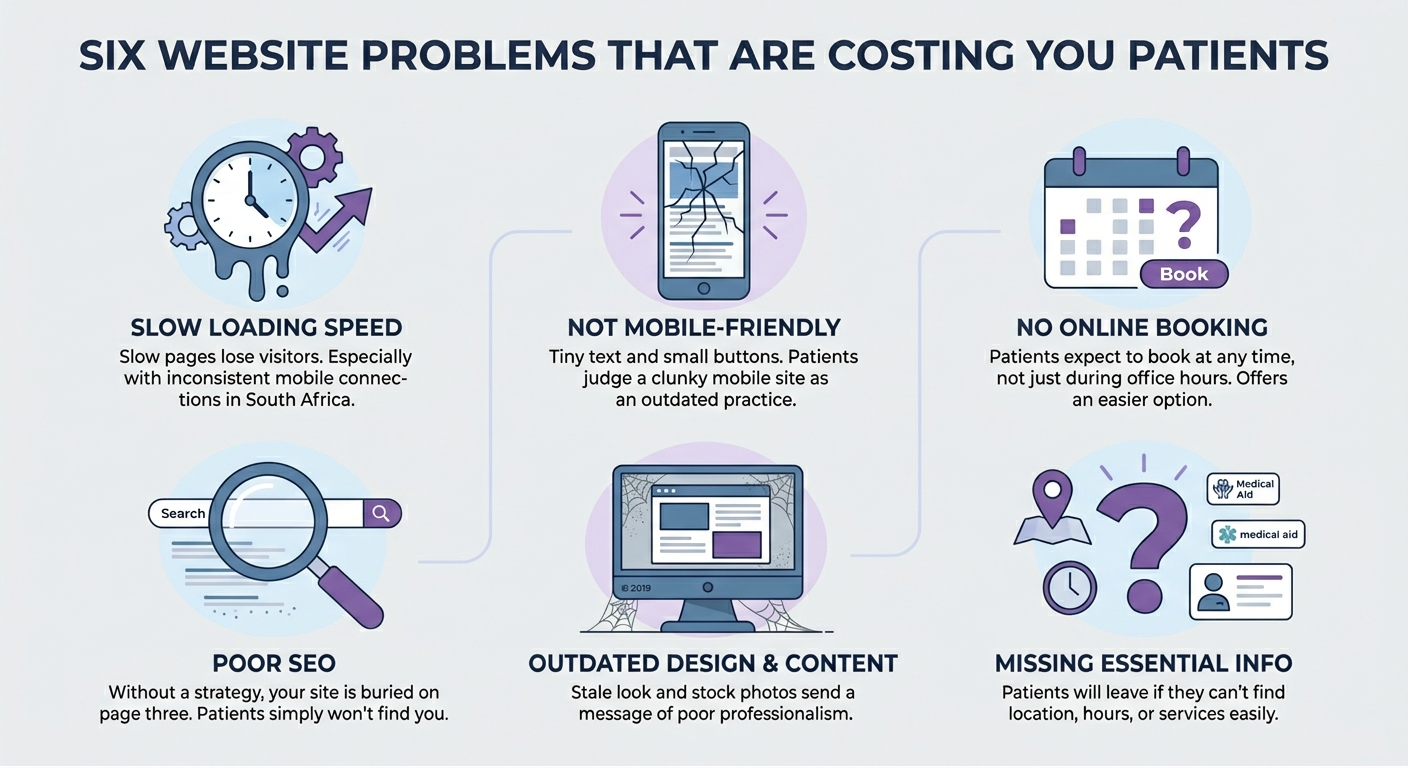
Six Website Problems That Are Costing You Patients
Through our work with healthcare practices across South Africa, we see the same critical mistakes repeated again and again. Any one of these can drive patients away. Most practices are guilty of several.
1. Slow Loading Speed
Page speed is the single most underestimated factor in patient acquisition. A site that takes five or six seconds to load will lose the majority of visitors before they see a single word of content. This is especially damaging in South Africa, where mobile connections can be inconsistent and data is expensive. Every unnecessary megabyte of unoptimised images, bloated plugins, and poorly written code is a patient walking out the door.
2. Not Mobile-Friendly
Tiny text that requires pinching to read. Buttons so small they are impossible to tap accurately. Menus that do not open properly on a phone screen. These are not minor inconveniences; they are trust-killers. A patient struggling to navigate your site on their phone will conclude, consciously or not, that your practice is behind the times.
3. No Online Booking
Patients increasingly expect to book appointments online, at any time of day, without needing to phone during office hours. A website that simply lists a phone number and says "call to book" is losing patients to the practice down the road that offers a simple online booking form. This is especially true for younger patients and working professionals who search for healthcare services outside of business hours.
4. Poor Search Engine Optimisation (SEO)
Having a website is not enough if nobody can find it. Many medical practice websites in South Africa have no SEO strategy whatsoever: no location-specific keywords, no Google Business Profile integration, no structured data markup, and no content strategy. The result is a site that exists but is buried on page three of Google, where almost nobody looks.
5. Outdated Design and Content
A website that looks like it was built in 2012 sends a clear message to patients: this practice has not kept up. Healthcare is a field where trust and competence are paramount. If your site features stock photos of smiling people in lab coats, a "Copyright 2019" in the footer, and no recent updates, patients will question whether your clinical practice is equally stale. Your website's design is a proxy for your professionalism.
6. Missing Essential Information
Patients visiting your website have specific questions: Where are you located? What are your hours? What medical aid schemes do you accept? What services do you offer? Who are the practitioners? If this information is missing, buried, or out of date, patients will not phone to ask. They will simply leave and find a practice that gives them the answers upfront.
How a Poor Website Erodes Patient Trust
The connection between website quality and patient trust is well-documented. Studies in health communication have found that up to 94% of first impressions of a healthcare provider are design-related. Patients use visual cues, loading speed, ease of navigation, and content quality as signals of the practice's overall competence and reliability.
Think about it from the patient's perspective. If a practice cannot manage a functional, professional website, what does that say about how they manage patient records, appointment scheduling, or clinical processes? It may not be a fair comparison, but it is the one patients are making, often subconsciously, every single day.
The Cost of Doing Nothing
Every month that your medical practice website in South Africa remains underperforming, you are losing patients to competitors who have invested in their digital presence. This is not hypothetical. Consider a practice that sees just five fewer new patients per month because of a poor website. At an average lifetime patient value of several thousand rands, that translates to tens of thousands in lost revenue every single month, compounding over time.
The competitive landscape is shifting quickly. Medical aids are adding online directory features. Platforms like Medpages and Discovery's provider search are funnelling patients toward practices with strong digital profiles. Independent practices that neglect their website are not just standing still; they are actively falling behind.
What a High-Converting Medical Practice Website Looks Like
The good news is that a medical practice website in South Africa does not need to be complex to be effective. It needs to be fast, mobile-first, trustworthy, and designed to convert visitors into booked patients. Here is what that looks like in practice:
- Lightning-fast load times: Optimised images, clean code, and fast hosting that loads in under two seconds, even on mobile data.
- Mobile-first responsive design: Built for the phone screen first, then scaled up to desktop. Easy-to-tap buttons, readable text, and intuitive navigation.
- Online booking integration: A clear, prominent booking form or integration with appointment scheduling software that lets patients book 24/7.
- Local SEO optimisation: Location-specific keywords, Google Business Profile integration, structured data markup, and a content strategy that helps you rank for the searches patients are actually making.
- Trust signals throughout: Real photos of your practice and team, practitioner qualifications, medical aid logos, and HPCSA registration details.
- Essential information front and centre: Operating hours, location with Google Maps embed, services offered, accepted medical aids, and clear contact details on every page.
- Professional, modern design: Clean layout, consistent branding, and a design that reflects the standard of care patients can expect from your practice.
Taking the First Step
If reading this article has raised concerns about your own practice's website, you are not alone. The majority of medical practice websites we audit have significant room for improvement. The important thing is to start, and to work with a team that understands both the healthcare sector and the South African digital landscape.
At Kaizen Technology, we specialise in building websites for healthcare practices that do more than just look good. They are engineered to attract patients through search, build trust through design, and convert visitors into bookings. You can explore our healthcare web design packages to see how we approach this for practices like yours.
Your medical practice website in South Africa should be your hardest-working team member: bringing in new patients around the clock, reinforcing your professional reputation, and making it effortless for people to choose your practice. If it is not doing that today, it is time to find out why.